

Meet our Founder
The unlikely journey from a small Gloucestershire village, to Sales Academy and why Adam Brooks eventually learned that moving forward doesn’t always mean pushing harder.
Detention gave me an education
There is a version of this story that would be much easier to write.
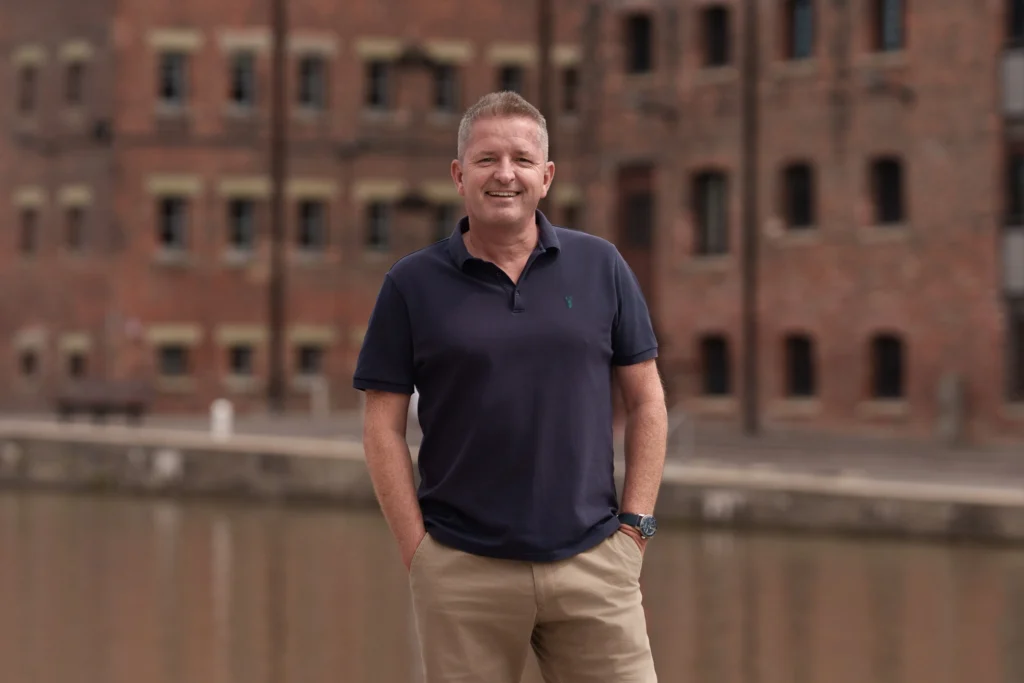
Adam Brooks, founder of Sales Academy. Decades of experience. Successful corporate career. Built businesses. Coached business owners. Trained sales teams. Speaker. Writer. Author.
All true.
And almost entirely useless if you actually want to understand the person behind Sales Academy.
Because the more interesting story starts long before the job titles, turnover figures, coaching programmes and stages.
It starts with a small boy in a small Gloucestershire village. And a detention.
School wasn’t somewhere Adam particularly flourished. Born and bred in Gloucestershire and raised in the beautiful village of Newnham on Severn, his earliest experiences of education weren’t particularly happy ones.
He was singled out and bullied by his headmaster, Daily. When he moved into comprehensive school, that feeling of not quite fitting followed him. His form tutor was also his maths teacher and IT teacher, and another difficult relationship meant school never really became somewhere Adam felt he belonged.
He did what plenty of kids who don’t quite fit the system do. He acted up. Nothing particularly dramatic. Low-level rebellion. Enough to push against the edges. And enough to earn detention. Forty-five minutes, sometimes ninety, in the library.
It wasn’t much of a punishment. Because somewhere among those shelves, books and copies of National Geographic, something happened.
A small boy from a small place discovered just how enormous the world was. Countries he’d never visited. People he’d never met. Ideas he’d never considered. Cultures, landscapes, psychology, stories, possibility. His body might have been stuck in detention. His mind wasn’t.
Adam’s grades weren’t remarkable. University wasn’t really on the radar. He tried college, but there was never a grand academic plan waiting for him. What was there, although he probably wouldn’t have called it this at the time, was curiosity. And curiosity turned out to be far more important.
The boy who wasn’t particularly academic became a learning sponge. He just needed to discover learning on his own terms. Education and learning aren’t necessarily the same thing.
Before the world got bigger
There was another education happening outside school. Growing up in Newnham in the 1970s meant freedom. Proper, old-fashioned, disappear-for-hours freedom. Working parents, bikes, fields, dens, adventures, outdoor skills. Two or three really good friends. The sort of childhood where you went exploring and eventually came home.
Nobody was tracking your phone. There wasn’t a phone. You learned by doing. You fell off things. Built things. Got things wrong. Worked things out. It gave Adam something that would become increasingly important throughout his life: independence.
But places change as we change. The village that had felt enormous as a child began to feel very different as a teenager. Employment opportunities were limited. Options felt limited. Gloucester was twelve miles away and, without transport, twelve miles might as well have been a hundred. Freedom started to feel like confinement.
Adam had worked as a head waiter in the village, but a summer job in a swimming-pool chemical factory offered something different. Money, work, possibility. College disappeared from the plan and the summer job became a full-time one. There was just one slight problem. Adam couldn’t drive. So he cycled. A 25-mile round trip when overtime was available. When the factory moved, the journey became 42 miles.
There are probably easier ways to demonstrate that somebody has a fairly determined streak. Eventually came the driving licence. For most seventeen and eighteen-year-olds, passing your test means independence. For Adam, it meant something bigger. The map opened.
Britain became the classroom
One of the most influential jobs of Adam’s early working life involved travelling around the UK servicing swimming pools. England, Wales, Scotland. Miles and miles of road. For a young man who had grown up feeling increasingly contained by a small village, it was extraordinary.
The boy who had travelled through National Geographic was suddenly travelling for real. He saw just how beautiful the UK was. He met people from different backgrounds and different places. He walked into businesses and homes and learned to talk to strangers. And, perhaps most importantly, he was trusted.
Get in the vehicle. Go there. Solve the problem. Look after the customer. Get yourself home.
There wasn’t somebody standing over him every five minutes telling him what to do. He was, within the boundaries of the job, his own boss every day. Looking back, it isn’t difficult to see why that mattered. Autonomy has been a recurring theme throughout Adam’s life. And somewhere among all those miles, another part of him started emerging. The writer.
He had always loved storytelling. At school, English assignments could become sprawling stories that he struggled to bring to an end. In his teens there had been poetry and attempts at songwriting. Now, travelling Britain, he wrote poetry again. Some of it was entered into competitions. Some was published.
There was no masterplan to become an author. He simply liked words. And he liked what happened when thoughts that were difficult to make sense of in his head appeared on paper. He kept reading too. Books became a constant. Psychology, behaviour, people, business, philosophy. Whatever question had grabbed him next. On average, roughly two books a month from his teenage years onwards. The supposedly non-academic kid never stopped learning. He just never went back to waiting for somebody else to create the curriculum.
Then things got serious
Work got bigger. Responsibilities got bigger. Teams got bigger. Eventually Adam found himself, at just 25, running a contact centre attached to a Home Office contract, responsible for a team of more than 70 people and a group of shift managers. The work involved the supervision and rehabilitation of offenders in the community. That’s quite an education in people. Different backgrounds. Different motivations. Different behaviours. Different pressures.
Communication stopped being something theoretical. It mattered. Leadership mattered. Choices mattered. And Adam started recognising something he’d been doing for years without having a name for it. Coaching.
An old profile written years before Sales Academy became what it is today describes him as having coached for as long as he could remember, before he even realised that was what he was doing. He’d previously labelled it leadership, people management, situational leadership or conflict management. The labels changed. The fascination didn’t.
Why do people do what they do?
Why does one person respond to pressure by growing while another retreats?
Why can somebody know exactly what they need to do and still not do it?
Why do intelligent people make decisions that work against what they say they want?
Why can one conversation change somebody’s direction?
Those questions would eventually become central to Adam’s work. But there was another lesson coming. One he would need to learn more than once. Success has a cost when you don’t know when to stop. Even at 25, Adam recognised that he had effectively become married to the job. At the time, the solution seemed obvious. Change the job. It would take much longer to realise that sometimes you also have to change the person doing it.
The corporate years
The next chapter brought commercial experience on a much bigger scale. Major organisations. Major brands. Customer service. Sales. Leadership. Targets. Restructures. Acquisitions.
Adam moved into the world of InBev, formerly Interbrew and Whitbread, working around brands including Stella Artois, Beck’s, Bass and Hoegaarden and supporting a team of more than 100 customer service and sales-people.
He learned the commercial game. And he was good at it. A later biography records experience across private and public sector environments and helping turn a £5 million contract into a £10 million contract in under four years.
The numbers matter. But they aren’t really the story. Because while Adam was learning how large organisations worked, he was also becoming increasingly frustrated by the gap between what organisations said and what they sometimes did.
Companies talked about people being their greatest asset, then the people-development budget was the first thing cut. Businesses displayed values, then made decisions that appeared to contradict them. Leaders announced transformation programmes, but sometimes the organisation itself hadn’t genuinely accepted that it needed to change.
Adam describes it as trying to turn a battleship that doesn’t even realise, or perhaps doesn’t want to admit, that it’s a battleship. Eventually that gets exhausting. He had achieved things. He had responsibility. He had learned enormously. But achievement and fulfilment aren’t the same thing. And beer, as he rather candidly wrote at the time, eventually wasn’t a good enough reason to get out of bed in the morning. Something else was calling.
Becoming the coach
Then came a phone call. Adam was approached about business coaching. There was a slight problem. He didn’t know business coaching existed. There was also something rather fitting about it.
Here was somebody who had spent years leading people, developing people, questioning people, challenging people and trying to create environments in which people could perform better. And somebody was suggesting he could build a business doing precisely that.
He took the leap. The corporate employee became the business owner. And in 2011, Sales Academy was born. The philosophy was already taking shape. Training alone wasn’t enough. Information wasn’t enough. Knowing wasn’t enough.
People needed knowledge, certainly, but they also needed the opportunity to apply it. To practise. To be challenged. To reflect. To be held accountable. To have somebody ask the question they might rather avoid.
An early Sales Academy biography captures the belief clearly: development had to involve the ongoing transfer of knowledge followed by the facilitation of that knowledge if people were genuinely going to succeed.
That belief remains deeply embedded in Sales Academy today. But the person delivering it has changed enormously. Because building a business was about to teach Adam considerably more about himself than any business book ever could.
Keep pushing forward
Build. Grow. Achieve. Next target. Next opportunity. Next person. Next idea. Next level. Keep pushing forward.
For much of Adam’s life, that felt like progress. And to be fair, sometimes it was. Drive gets things done. Ambition creates things that didn’t previously exist. A willingness to take responsibility and move can change your circumstances.
Even Adam’s old psychometric profiles make for interesting reading today. Dominance. Inspiration. Independence. Challenge. Optimism. Pace. Ideas. Risk. The desire to make things happen.
Plenty of strengths. But every strength has a shadow when you turn the volume up too far. Drive can become impatience. Independence can make it difficult to ask for help. Confidence can overpower quieter voices. Optimism can underestimate risk. Resilience can become an excuse to tolerate things you shouldn’t. And pushing forward can become so habitual that you forget to ask whether forward is actually where you want to go.
Sales Academy grew. At one point the business had nine people. From the outside, that can look like success. More people. More activity. More growth. More. And then came 2019.
The morning everything stopped
Adam woke up believing he was dying. Not metaphorically. He genuinely thought he was dying. There are moments when life gently suggests you might want to reconsider a few things.
This wasn’t one of them. This was Dickens arriving with all three ghosts. It forced an uncomfortable confrontation. Not simply with work. With himself.
Because it would be easy to tell this part of the story as though life had happened to Adam. It hadn’t. Some of it had. But some of it was his. He had pushed. He had made decisions that weren’t right for him. He had made decisions that weren’t right for other people either. He had built parts of his life around assumptions that now needed questioning. And if he was going to take ownership of the successes, he also had to take ownership of the consequences.
So, he pulled the pins. Business, private life, assumptions, direction. The lot. Reset. Not overnight. Not perfectly. Not without consequences. And certainly not with the neatness hindsight sometimes tries to impose on difficult periods of our lives.
But something fundamental changed. Instead of beginning with What do I need to do next?, Adam began going further upstream. What are my intentions? What outcome am I actually trying to create? What do I believe? Because beliefs influence decisions. Decisions create direction. And direction, repeated for long enough, creates a life.
Pruning isn’t failure
One of the hardest lessons for ambitious people is that growth doesn’t always mean
getting bigger. Sometimes growth looks like cutting something back. Anyone who has properly pruned a plant understands the apparent contradiction. You remove healthy-looking growth. It can look brutal. It can look as though you’re making the thing smaller. But you’re creating the conditions for stronger, healthier growth in the direction you actually want.
Adam pruned. The business changed. His priorities changed. His understanding of success changed. And perhaps most importantly, his relationship with the word more began to change.
Because for most of his life, Adam believed he needed to keep pushing forward. There’s always another level, isn’t there?
Another target. Another client. Another pound. Another employee. Another house. Another holiday. Another achievement. Another version of yourself you’re apparently supposed to become before you’re finally allowed to feel you’ve arrived.
More.
It’s one of society’s most successful bits of conditioning. And Adam had been very good at it. Today, he sees things differently. Not because ambition disappeared. It hasn’t. Not because growth stopped mattering. It doesn’t. Not because he stopped building things.
Anyone who knows Adam will know how ridiculous that suggestion would be. The difference is that growth is no longer automatically synonymous with accumulation. Sometimes the courageous thing is to grow. Sometimes it’s to shrink. Sometimes freedom needs structure. Sometimes certainty is built by becoming more comfortable with uncertainty. Sometimes abundance comes from giving rather than acquiring. And sometimes the fastest way forward is to slow down. Those contradictions aren’t irritating exceptions to life. Increasingly, Adam believes they’re where some of life’s most important lessons are hiding.
Sales, properly
The same evolution happened in Adam’s understanding of sales. Spend enough time around traditional sales training and you’ll hear a lot about closing. Scripts, objections, techniques, control, getting the deal over the line.
Adam’s view for decades now has been rather different. Sales is human. It’s conversation. Curiosity. Trust. Communication. Listening. Understanding behaviour. Having enough courage to ask a meaningful question and enough emotional maturity to listen properly to the answer.
It’s not about doing something to somebody. It’s about opening something with somebody. That’s why Sales Academy doesn’t simply train sales techniques. And it’s why the work increasingly crosses the boundaries between sales, business coaching, leadership, psychology, accountability and personal development.
Businesses are built by people. People bring themselves with them.
Their confidence. Their fear. Their history. Their beliefs. Their relationships with money. Their need for approval. Their avoidance. Their courage. Their ego. Their values. Their blind spots.
You can’t always neatly separate the person from the business they’re trying to build. Adam stopped trying to.
The business is the vehicle
Over the years, Sales Academy has worked with businesses of different sizes, sectors and stages.
Some have wanted to grow. Some needed to stop growing badly. Some needed better sales. Some needed better systems. Some needed accountability. Some needed a strategy. Some needed the owner to get out of their own way.
And some owners didn’t need another answer at all. They needed somebody willing to have the conversation everybody else was avoiding. That has increasingly become the work. Support, certainly. But challenge too. Not challenge for theatre. Not somebody shouting from the sidelines. Purposeful challenge.
Care enough to ask. Care enough to listen. Care enough to disagree occasionally. Care enough not to become another person telling somebody what they want to hear.
Because Adam’s definition of a successful business has changed too. Business matters. Profit matters. Sales matter. Employment matters. Growth matters. But the business is the vehicle. It isn’t the destination.
If the thing you created to give you a better life eventually consumes the life it was supposed to support, it’s reasonable to question the definition of success being used. Adam learned that one the hard way.
The reader becomes the writer
Meanwhile, the books never went away. Neither did the writing. The teenager writing poetry became the business owner writing articles.
From around 2009 onwards, Adam wrote regularly about sales, business, leadership, behaviour, confidence, ownership and the often-messy reality of trying to build something. Writing became another form of coaching. A way of taking something complicated and turning it around until it could be looked at differently.
Sometimes practical. Sometimes provocative. Sometimes deeply personal. Sometimes beginning with something as ridiculous as a buzzard being harassed by seagulls and somehow ending up as an article about criticism, focus and running a business.
The subject was rarely really the subject. There was usually a human being underneath it. Eventually those decades of reading, questioning, coaching, speaking, making mistakes, changing his mind and writing collided. The reader became an author.
Not because Adam finally became “academic”. He still wouldn’t describe himself that way. Something much more useful happened. He became comfortable being a student. Of business. Of psychology. Of people. Of himself. And there is always another question.
Think & Act Differently
Perhaps inevitably, the philosophy eventually found its way into a podcast, and then into a book.
Think & Act Differently isn’t the story of somebody who worked everything out and came back with the answers. Adam would be deeply suspicious of that person. It is built from something messier.
Experience. Mistakes. Conversations. Ideas. Business. Pressure. Choice. Responsibility. Values. Identity.
The stories we tell ourselves. The moments when our head ends up in the shed. The moments when we realise we’ve been 90% off course. The moments when we have to decide whether we’re above or below the line. The moments when slowing down is the only sensible way to speed up. And ultimately, the person staring back from the mirror.
Because after decades of coaching businesses, teams and individuals, Adam keeps arriving at essentially the same place. Ourselves.
Not because circumstances don’t matter. They absolutely do. Not because everything that happens to us is our responsibility. It isn’t. But because somewhere between what happens and what happens next, there is usually a conversation worth having about choice.
That conversation has fascinated Adam since a pile of books and National Geographic magazines first opened the world to him. He just has better questions now.
So, who is Adam Brooks? Founder of Sales Academy? Yes. Business coach? Absolutely. Sales trainer? For decades. Speaker? Yep. Writer and author? Finally, officially.
But none of those quite gets there.
He’s still the Gloucestershire boy at heart. Still happier questioning an accepted answer than blindly following it. Still fascinated by psychology and human behaviour. Still capable of disappearing down a rabbit hole because he’s found an idea he wants to understand. Still driven. Still impatient sometimes. Still capable of taking on too much. Still learning when to push and when to stop. Still getting things wrong. Still changing his mind. Still becoming.
Because this isn’t one of those founder stories where the difficult bits happened in Act One so that the hero could become the finished product in Act Three. There is no finished product. And that’s rather the point.
From more to gratitude
If you asked the younger Adam what progress looked like, the answer would probably have involved movement. Forward. Next. More.
Today, the answer is different. Gratitude.
Gratitude for what got him here. Including some of the things he wouldn’t willingly choose to experience again. Gratitude for what’s already here.
The people. The conversations. The work. The experiences. The opportunities. The choices. The lessons.
And gratitude for what is still to come, without needing to know exactly what it looks like yet. That’s not resignation. It’s not a lack of ambition. It’s perhaps a more mature relationship with ambition.
The freedom to build without believing your worth depends upon what you build next. The ability to pursue tomorrow without completely missing today. For most of his life, Adam thought he had to keep pushing forward.
Now he understands how much of that was wrapped up in our conditioning towards more. More success. More growth. More achievement. More proof.
These days, there’s another word competing for his attention. Enough.
Not I’ve done enough. Not I’ve got enough. Not stop trying. Something quieter.
Look around. Notice what got you here. Notice who is here. Learn from what wasn’t right. Take responsibility for what was yours. Forgive what needs forgiving. Be grateful for what remains. And then decide what comes next.
Not because society told you to keep moving. Because you’ve consciously chosen the direction.
The story continues
Sales Academy is part of Adam’s story, but it isn’t all of it. Today his work increasingly sits at the intersection of business, sales, psychology, human behaviour, speaking and writing. The boy who found the wider world from a library in detention is still exploring it. He’s just doing more of the writing now.
To discover more about Adam Brooks, his writing, speaking, podcast and books, visit the Adam Brooks website.
And if you’ve arrived here because you’re wondering whether Sales Academy might be the right place for your business, perhaps don’t begin by asking what programme you need. Start somewhere more useful.
What conversation have you been avoiding?
Source note: This founder story was developed from Adam Brooks’ personal recollections, historical biography/profile material and psychometric profile information supplied for the article.